
Everest Trek Day: 15
From Namche our strategy changed. altitude gain, now the primary concern, constrained the distance we could travel each day. Whereas prior to Namche we were walking 7-9 hours a day, now we were down to leisurely strolls rof about two hours. At first this new speed laboriously slow, but as the air thinned even small slopes left us breathless.
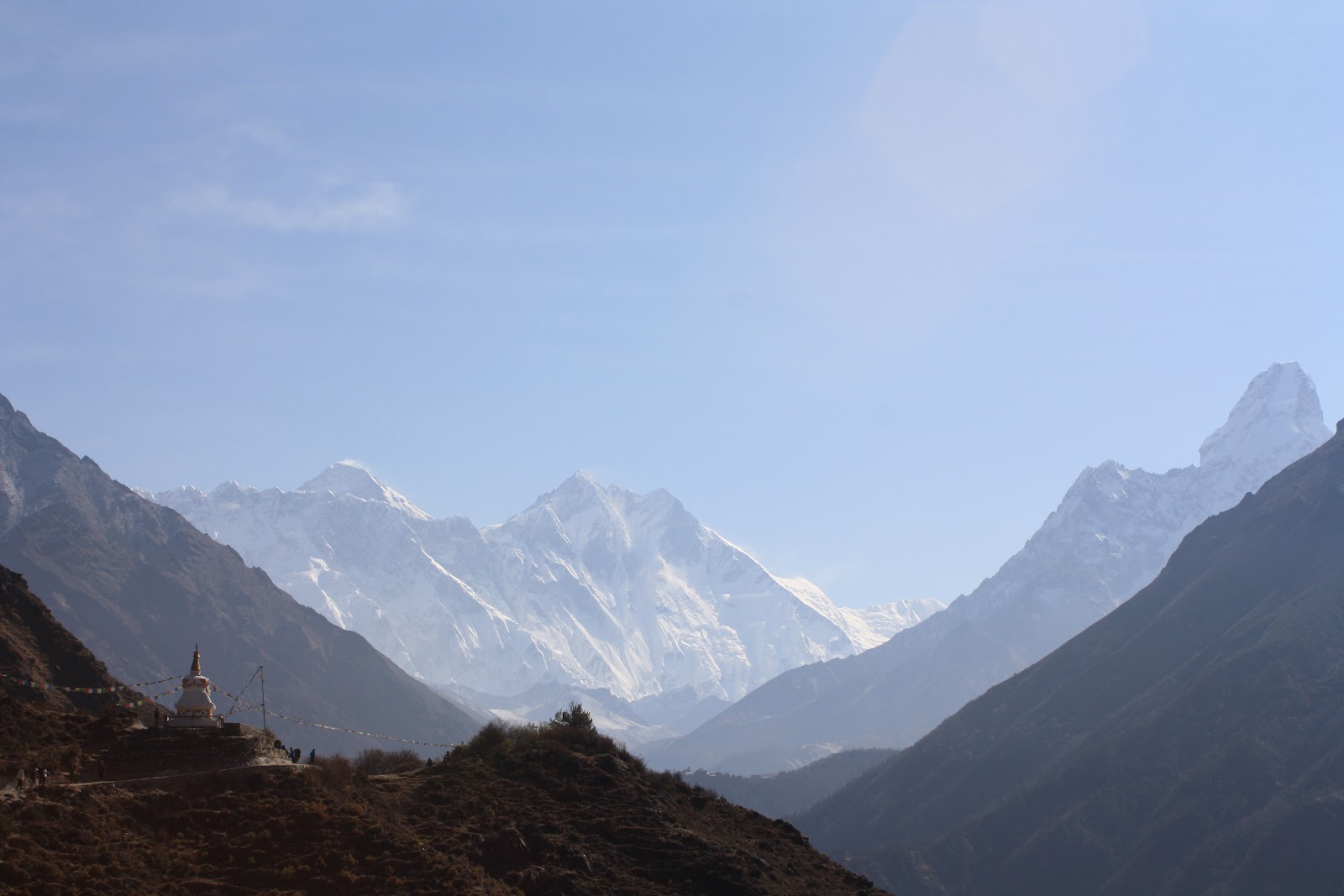
 With every passing day the scenery became more dramatic as high snowy peaks closed in around us. Unlike the punishing trail from Jiri, the route from Namche gently climbed up the Khumbu valley, following the icy blue river that flowed down from the Khumbu glacier at Everest. The forests thinned, giving way to stunted alpine shrubbery and then to open tundra. Instead of donkeys we were now passed by caravans of yaks. Everywhere colourful prayer flags fluttered in the wind. The trail, winding past sacred rock carvings and cairns of religiously piled stones. Every now and then we would pass a Sherpa carrying a massive load on their back, a cabinet perhaps, wooden beams, gas bottles, fuel. An amazing feat of strength but a telling sign of the state of Nepal's economy. There must be few places in the world where using humans for transportation is still cheaper than animal labour.
 It's hard to describe the Himalayas. In Australia we have only hills, gently sculpted by the millennia. Here the mountains thrust into the sky as pointed, jagged walls of snowy rock. They were so close and yet so high above us. Here the forces of nature oppose to carve a dramatic landscape. Tectonic plates push upwards and ice grinds downwards. Every now and then we would spot Everest, there in the distance, an unassuming peak really. It's easy to see why it was not known to be the highest for so long, as it is surrounded by many other seemingly higher (perspective wise) and more dramatic mountains.
As I mentioned, altitude was the enemy. Taking it slow minimised the symptoms of oxygen deprivation to a few minor headaches. The human body has to pull off a feat of adjustment to survive up here. Part of acclimatisation involves the body expelling excess carbon dioxide (building up due to the lack of oxygen) as bicarbonate ions in urine. This leads to an increase in urination, and I mean litres and litres every day. I felt my kidneys pulled off quite a hydrological feat. Then there were the wild and vivid dreams, often dark and nightmarish. All part of normal acclimatisation. At our highest point the atmosphere was only 50% the pressure of sea level.
As before we stayed each night, and now some of our days in lodges. Most were nice, with warm dining rooms. One was cold and smelt of urine. After a mornings trek we could spend the afternoon reading, eating, writing, playing cards or wandering about the mountains. It was such a contrast to the first week in which days consisted of walk, eat, bed. As we climbed so did the prices. It was something of a shock for someone who is accustomed to spending $2 on his dinner. $5 shower anyone? I can imagine I smell quite bad.

From Namche our strategy changed. altitude gain, now the primary concern, constrained the distance we could travel each day. Whereas prior to Namche we were walking 7-9 hours a day, now we were down to leisurely strolls rof about two hours. At first this new speed laboriously slow, but as the air thinned even small slopes left us breathless.
 |
| The walk from Namche |

 |
| Prayer Flags Flutter in the wind |

As I mentioned, altitude was the enemy. Taking it slow minimised the symptoms of oxygen deprivation to a few minor headaches. The human body has to pull off a feat of adjustment to survive up here. Part of acclimatisation involves the body expelling excess carbon dioxide (building up due to the lack of oxygen) as bicarbonate ions in urine. This leads to an increase in urination, and I mean litres and litres every day. I felt my kidneys pulled off quite a hydrological feat. Then there were the wild and vivid dreams, often dark and nightmarish. All part of normal acclimatisation. At our highest point the atmosphere was only 50% the pressure of sea level.
As before we stayed each night, and now some of our days in lodges. Most were nice, with warm dining rooms. One was cold and smelt of urine. After a mornings trek we could spend the afternoon reading, eating, writing, playing cards or wandering about the mountains. It was such a contrast to the first week in which days consisted of walk, eat, bed. As we climbed so did the prices. It was something of a shock for someone who is accustomed to spending $2 on his dinner. $5 shower anyone? I can imagine I smell quite bad.


Wow! Amazing pictures of an inspiring place.
ReplyDelete$5 for a shower? It's good you gave that a miss. You can shower all you like at a more reasonable altitude and a more reasonable price, now you're done.
ReplyDeleteI'm afraid that after weeks of Trekking we did have to indulge in the shower once or twice.I made sure I took a very long shower.
Delete